
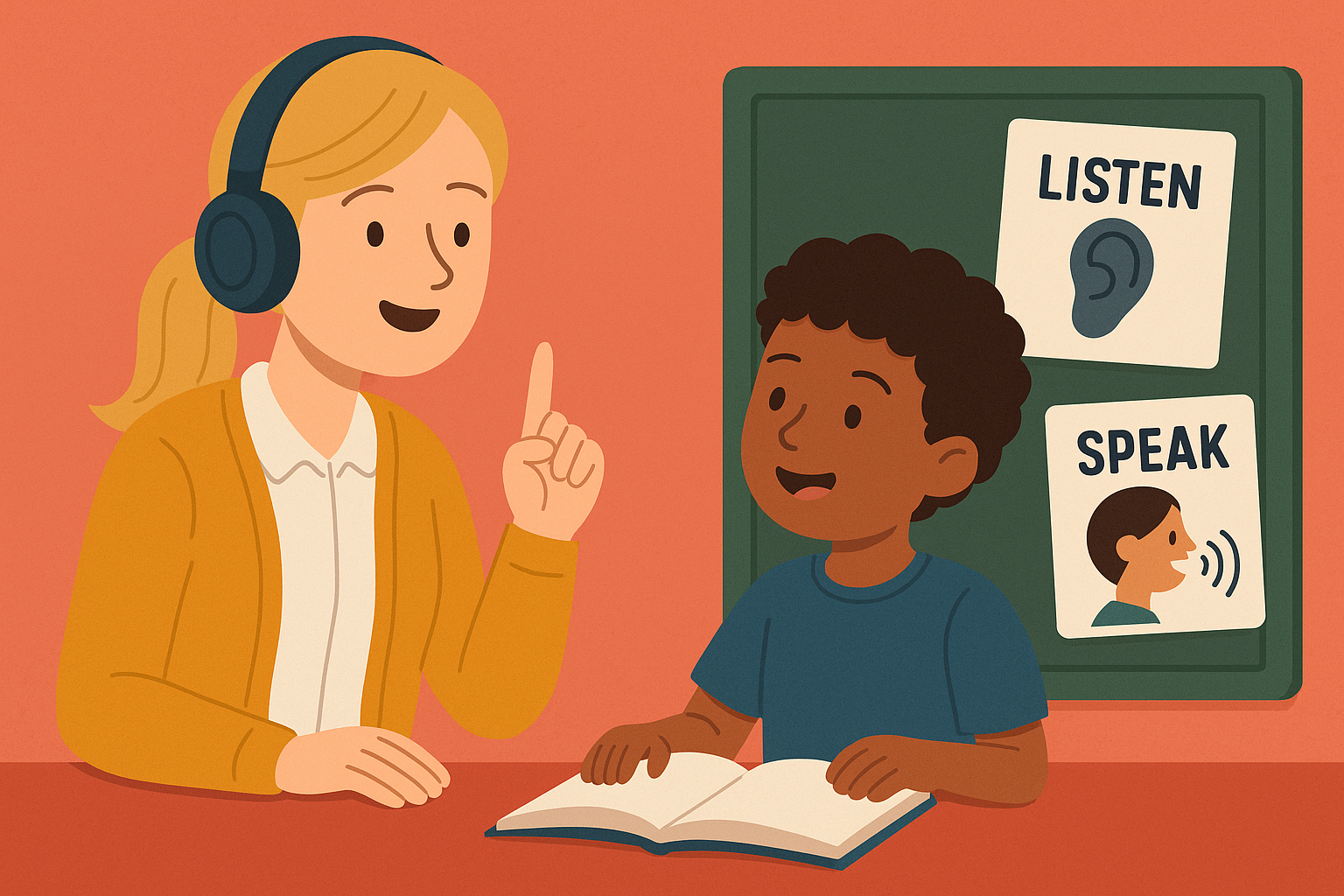
Listen First, Speak Better: Easy English Activities for Young Learners
🌟Why Listening Comes Before Speaking
Before children speak fluently, they listen. That’s how we all learn our first language — by hearing rhythm, tone, and real conversation patterns long before we say a word.
For young English learners, listening practice is the foundation of good pronunciation, comprehension, and confidence. The more they listen to authentic English sounds, the easier it becomes to think and speak naturally.
In this guide, we’ll explore simple, kid-friendly listening activities you can do at home or in class — no fancy materials, just creativity and sound.
🎶 1. The “Sound Detective” Game
Goal: Improve attention and vocabulary through fun sound recognition.
How it works:
- Play a short sound clip — it could be an animal, object, or action (e.g., door closing, cat meowing).
- Ask, “What sound is this?” or “Who makes this sound?”
- When they answer correctly, repeat the word together: “Yes! Cat. The cat says meow.”
Why it works: Kids strengthen listening discrimination and connect meaning with sound — a key pre-speaking skill.
🎵 2. Sing-and-Repeat Songs
Goal: Practice pronunciation and rhythm through melody.
What to do:
- Choose slow, clear English songs (e.g., “If You’re Happy and You Know It”, “Baby Shark”, “Let It Go”).
- Sing one line, pause, let your child echo.
- Emphasize rhythm, not perfection.
Tip: Use YouTube lyric videos or EnglishLesson.com’s printable song word sheets for guided singing.
🗣️ 3. “Copy the Voice” Challenge
Goal: Build speaking confidence through imitation.
How it works:
- Play a simple line from an English cartoon or story (e.g., “Let’s go!”, “It’s time for school!”).
- Let your learner repeat exactly, copying tone and emotion.
- Praise effort, not accuracy.
Variation: Record both voices and play them side-by-side for fun comparison.
🎯 Learning tip: Mimicking tone helps children sound more natural than memorizing grammar rules.
🎧 4. Listening Treasure Hunt
Goal: Strengthen comprehension through action listening.
How it works:
Give instructions like a game:
“Find something red.”
“Touch the door.”
“Put your hand on your head.”
Start simple, then increase complexity:
“Before you sit down, clap three times!”
Result: Children connect listening with real movement, reinforcing understanding before verbal response.
📚 5. Storytime Echo Reading
Goal: Improve vocabulary and sentence rhythm.
How to do it:
- Choose a short illustrated story.
- Read a line aloud; your child repeats after you.
- Add expression and gestures to make it memorable.
Bonus: Pause mid-sentence and let your learner guess the next word — this builds predictive listening, a skill native speakers use constantly.
💡 6. “What Did You Hear?” Game
Goal: Test comprehension through fun recall.
After playing a short audio (song verse, story clip, or dialogue), ask quick questions:
“Who was talking?”
“What color was the car?”
“Where did they go?”
This turns passive listening into active processing — vital for developing both understanding and speech.
🏁 Listen Well, Speak Wonderfully
Every confident speaker begins as a good listener. 👂✨
By focusing on listening first — through songs, games, and stories — children build the sounds of English in their minds before speaking.
So, the next time your child listens quietly to a story or hums along to a pop song, remember: they’re already learning to speak better.
🎧 Keep it fun. Keep it natural.
Listen first — and speaking will follow.