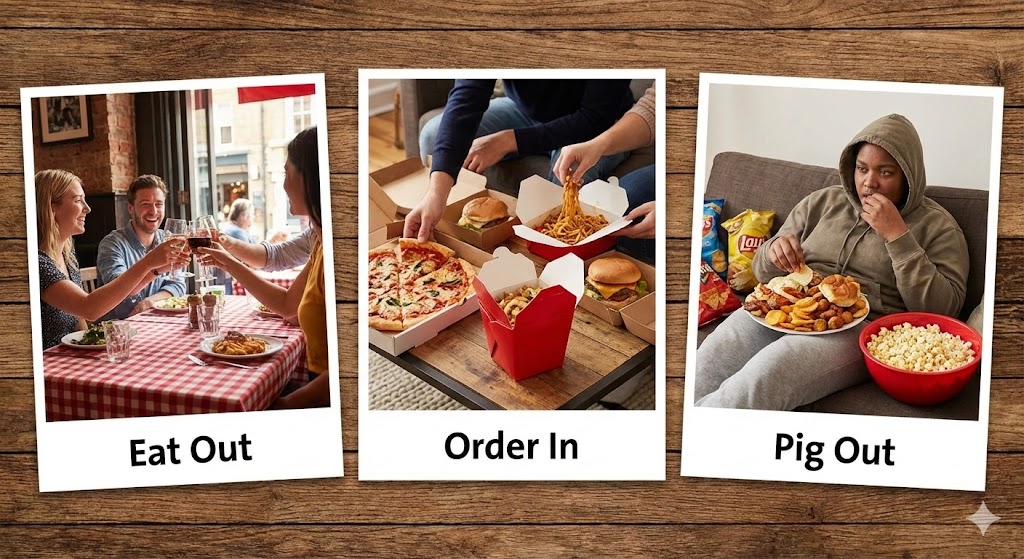
Eating and Drinking Phrasal Verbs: Eat Out, Order In, Pig Out 🍽️
Eating and drinking—universal daily activities—generate essential English phrasal verbs that native speakers use constantly to describe dining experiences, consumption habits, and food-related behaviors. When native speakers discuss their plans, they naturally say “let’s eat out tonight” rather than “let’s dine at a restaurant,” or “I’m ordering in” instead of “I’m having food delivered.” Understanding phrasal verbs like “eat out,” “order in,” “pig out,” “drink up,” “wolf down,” and “fill up” transforms textbook English into natural, conversational fluency. These expressions aren’t formal dining vocabulary—they’re everyday language for discussing meals, restaurants, eating habits, and food consumption.
Mastering eating and drinking phrasal verbs provides ESL learners with immediately applicable vocabulary for daily conversations about food—discussing dining plans, explaining eating habits, describing restaurants, and navigating social eating situations. Native speakers use these phrasal verbs unconsciously multiple times daily, making them essential for natural English comprehension and production. Whether making dinner plans, ordering food, describing your eating experience, or discussing dietary habits, these phrasal verbs form the linguistic foundation of food-related communication in English.
Why Eating/Drinking Phrasal Verbs Matter
Understanding these specific expressions provides multiple advantages.
Universal relevance: Everyone eats multiple times daily—this vocabulary applies constantly to lived experiences.
Social necessity: Making dining plans, discussing restaurants, and coordinating meals requires these expressions.
Natural speech: Native speakers default to phrasal verbs for eating contexts. “Eat out” sounds natural; “dine externally” sounds bizarre.
Cultural integration: Understanding dining phrasal verbs signals linguistic competence essential for social inclusion.
Restaurant navigation: Ordering food, understanding servers, and discussing meals all utilize these verbs.
High frequency: These rank among the most commonly used phrasal verbs in everyday English conversation.
Core Eating Phrasal Verb #1: Eat Out
Meaning: Dine at a restaurant; have a meal outside your home at a commercial eating establishment.
Opposite: “Eat in” (have a meal at home)
Usage: “Let’s eat out tonight—I don’t want to cook.” “We eat out twice a week usually.” “Do you want to eat out or eat in?”
Grammar patterns:
Present: “We eat out” Past: “We ate out” Future: “We’ll eat out” Progressive: “We’re eating out tonight”
Real-life examples:
Making plans: “I’m exhausted from work and don’t feel like cooking. Let’s eat out—maybe that new Italian place downtown? I heard their pasta is excellent.”
Weekly routine: “We eat out every Friday night—it’s our tradition. Sometimes casual places, sometimes nicer restaurants, but we always have a date night meal outside the house.”
Travel context: “When traveling, we eat out for every meal. Trying local restaurants is part of the experience—we’d never cook in hotel rooms.”
Budget discussion: “We’re trying to save money, so we’re eating out less frequently. Restaurant meals add up quickly—cooking at home is much more economical.”
Special occasions: “For my birthday, I want to eat out somewhere special—maybe that French restaurant with amazing reviews.”
Social gathering: “Let’s all eat out together after the conference—there’s a great seafood place nearby.”
Common collocations:
- Eat out at [restaurant/place] (“eat out at a steakhouse”)
- Eat out tonight/this weekend
- Eat out for [meal] (“eat out for dinner/lunch”)
- Eat out with [people] (“eat out with friends”)
- Eat out often/rarely/sometimes
Related expressions:
“Dine out” (more formal, same meaning) “We’re dining out at an upscale restaurant tonight.”
“Go out to eat” (same meaning, slightly different structure) “Want to go out to eat this evening?”
Important distinction:
“Eat out” = At a restaurant (commercial establishment) “Eat outside” = Physically outdoors (picnic, patio, garden)
Examples:
- “Let’s eat out tonight.” (Restaurant)
- “Let’s eat outside today.” (Outdoors, but could be home patio)
Core Eating Phrasal Verb #2: Order In
Meaning: Have food delivered to your location from a restaurant; request restaurant food brought to your home or office.
Opposite: “Eat out” (go to restaurant)
Modern context: Apps like DoorDash, Uber Eats, and Grubhub have made ordering in extremely common.
Usage: “I’m too tired to go out—let’s just order in.” “We’re ordering in pizza for the meeting.” “Should we order in or go pick it up?”
Grammar patterns:
Present: “We order in” Past: “We ordered in” Future: “We’ll order in” Progressive: “We’re ordering in tonight”
Real-life examples:
Busy evening: “It’s 8 PM, we just got home from work, both kids have homework, and nobody has energy to cook or go out. Let’s order in Thai food—it’ll be here in 30 minutes.”
Weather excuse: “It’s pouring rain outside. I don’t want to drive anywhere. Let’s order in and watch movies—perfect rainy evening.”
Work situation: “The team is working late to meet the deadline. I’ll order in dinner for everyone—pizza or Chinese? We need food but can’t take time for a restaurant.”
Hosting friends: “I’m having friends over but don’t want to cook. I’ll order in from that Mexican place—tacos, burritos, chips, and guacamole. Easy entertaining.”
Illness: “I’m sick with a cold and can’t leave the apartment. I’ll order in some soup and comfort food—delivery is a lifesaver.”
Lazy weekend: “It’s Sunday, we’re in pajamas watching TV, and neither of us wants to move. Let’s order in brunch—bagels, eggs, coffee delivered to our door.”
Common collocations:
- Order in from [restaurant] (“order in from the Indian place”)
- Order in for [event] (“order in for the party”)
- Order in [cuisine/food] (“order in Chinese/pizza”)
- Order in tonight/today
- Order in delivery
Related expressions:
“Get delivery” (same meaning) “Let’s get delivery tonight.”
“Have food delivered” (more formal description) “We’re having food delivered for the office lunch.”
Important distinction:
“Order in” = Food delivered to your location “Order out” = Less common, sometimes means ordering food for takeout/pickup “Take out” = Food you pick up yourself from restaurant
Examples:
- “Order in pizza.” (Delivered)
- “Get takeout pizza.” (You pick up)
Core Eating Phrasal Verb #3: Pig Out
Meaning: Eat excessively; consume a large amount of food, usually unhealthy food; overeat, often without restraint.
Tone: Informal, casual, often self-deprecating or humorous.
Connotation: Usually involves indulgent, often unhealthy foods—not a salad feast.
Usage: “We totally pigged out on junk food at the party.” “I’m going to pig out on pizza tonight.” “We pigged out on Thanksgiving and couldn’t move.”
Grammar patterns:
Present: “I pig out” Past: “I pigged out” Future: “I’m going to pig out” Progressive: “I’m pigging out on chips”
Real-life examples:
Holiday feast: “Thanksgiving dinner is when I allow myself to pig out completely. Turkey, stuffing, mashed potatoes, gravy, rolls, pie—I eat until I’m uncomfortably full. Worth it.”
Movie night: “Friday movie nights mean pigging out on popcorn, candy, nachos, and soda. We know it’s unhealthy but it’s our weekly treat.”
Post-diet indulgence: “I’ve been dieting strictly for two months. This weekend I’m pigging out—burgers, fries, ice cream, cookies, everything I’ve been denying myself.”
College lifestyle: “During finals week, students pig out on pizza, energy drinks, and junk food. Stress eating plus convenience.”
Vacation behavior: “Vacation calories don’t count, right? We pigged out on local food every day—pastries for breakfast, huge lunches, decadent dinners, late-night snacks.”
Sports event: “At the Super Bowl party, everyone pigged out on wings, nachos, chips, dips, and beer. The game is almost secondary to the food.”
Common collocations:
- Pig out on [food] (“pig out on ice cream”)
- Pig out at [event] (“pig out at the buffet”)
- Really pig out / totally pig out (intensifiers)
- Pig out on junk food
Variations:
“Stuff yourself” (similar but slightly more formal) “We stuffed ourselves at Thanksgiving.”
“Gorge yourself” (similar meaning, slightly more formal/negative) “They gorged themselves at the buffet.”
“Binge eat” (more clinical, can indicate problem behavior) “Binge eating is a serious health concern.”
Important note:
“Pig out” is informal and should be used casually among friends, not in formal situations. Also, while humorous when self-applied, be careful using it about others—it could sound offensive.
Additional Essential Eating/Drinking Phrasal Verbs
Eat Up / Drink Up
Meaning: Finish all your food or drink completely; consume everything.
Often used as command/encouragement.
Usage: “Eat up—we need to leave soon!” “Drink up! The bar is closing.” “The kids ate up all their vegetables tonight.”
Examples:
“My grandmother always says ‘Eat up! You’re too skinny!’ and piles more food on my plate.”
“The bartender announced last call: ‘Drink up, folks—we’re closing in ten minutes.'”
“My toddler actually ate up his broccoli without complaining. Miracle!”
Fill Up
Meaning: Become full; eat until you can’t eat more; become satisfied with food.
Usage: “I filled up on appetizers before dinner arrived.” “Don’t fill up on bread—save room for the main course.” “We filled up at the buffet.”
Examples:
“I made a mistake filling up on chips and salsa before my burrito arrived. Now I can’t finish my meal.”
“The restaurant’s bread basket is so good, but I can’t let myself fill up before the entrée.”
Wolf Down / Scarf Down
Meaning: Eat very quickly, often without chewing properly; devour food rapidly.
Tone: Informal, implies rushed or ravenous eating.
Usage: “I was so hungry I wolfed down my sandwich in two minutes.” “He scarfed down his breakfast and ran out the door.” “Don’t wolf down your food—you’ll get indigestion!”
Examples:
“I had only 15 minutes for lunch between meetings. I wolfed down a salad at my desk—not even sure I tasted it.”
“Teenagers wolf down entire pizzas in minutes. Their metabolism is incredible.”
Related: “Inhale” (informal, same meaning) “He inhaled that burger—it was gone in seconds.”
Snack On
Meaning: Eat small amounts of food between meals; consume snacks.
Usage: “I’m snacking on chips while watching TV.” “We snacked on fruit all afternoon.” “Stop snacking—dinner is in an hour!”
Examples:
“I try not to snack on junk food, but sometimes I need something crunchy while working.”
“She snacks on nuts and dried fruit throughout the day instead of eating big meals.”
Munch On
Meaning: Eat something casually and steadily, usually something crunchy; chew on snacks.
Usage: “He’s always munching on something.” “I was munching on popcorn during the movie.” “Stop munching on chips—you’ll spoil your appetite!”
Examples:
“During long drives, I munch on trail mix to stay alert.”
“She sits at her desk munching on carrot sticks—her constant healthy snack.”
Polish Off
Meaning: Finish eating or drinking something completely, often implying a large amount or enthusiastic consumption.
Usage: “We polished off two pizzas between the three of us.” “He polished off the entire cake by himself!” “They polished off three bottles of wine at dinner.”
Examples:
“The kids polished off a gallon of ice cream in two days—I can’t keep it stocked.”
“We were so hungry after hiking that we polished off everything in the fridge.”
Cut Down On / Cut Back On
Meaning: Reduce consumption of something; eat or drink less of a specific food/beverage.
Often health-related.
Usage: “I’m cutting down on sugar.” “My doctor told me to cut back on red meat.” “We’re cutting down on eating out to save money.”
Examples:
“I’m cutting down on coffee—four cups a day was too much. Now I limit myself to two.”
“We’re cutting back on processed foods and eating more fresh vegetables.”
Drink To
Meaning: Toast someone or something; raise your glass in honor of a person or occasion.
Usage: “Let’s drink to your success!” “I’d like to drink to the happy couple.” “We drank to his memory.”
Examples:
“At the wedding, guests drank to the bride and groom’s happiness.”
“On New Year’s Eve, we drink to new beginnings and better times ahead.”
Go Easy On / Go Light On
Meaning: Use or consume something moderately; not add much of an ingredient.
Often used when ordering.
Usage: “Can you go easy on the salt?” “I’ll have a burger—go light on the mayo.” “Go easy on the spices—I don’t like too much heat.”
Examples:
“When ordering my sandwich, I ask them to go easy on the dressing—they usually use too much.”
“I tell my doctor I go easy on alcohol—maybe one drink per week.”
Whip Up
Meaning: Prepare or cook something quickly and easily.
Usage: “Let me whip up some breakfast.” “She can whip up a delicious meal with whatever’s in the fridge.” “I’ll whip up a quick salad.”
Examples:
“It’s midnight and I’m hungry. I’ll whip up some scrambled eggs—takes five minutes.”
“My mother can whip up an amazing dinner for ten people with seemingly no effort.”
Common Patterns Across Eating/Drinking Phrasal Verbs
Understanding patterns helps master new verbs.
Pattern #1: “UP” for Completion
- Eat up (finish all food)
- Drink up (finish all beverage)
- Fill up (become completely full)
- Polish off (completely finish)
Insight: “Up” signals completion or totality.
Pattern #2: “ON” for Consumption
- Snack on (eat specific food as snack)
- Munch on (chew specific food)
- Cut down/back on (reduce specific consumption)
- Go easy on (moderate specific ingredient)
Insight: “On” indicates the object of eating/drinking or moderation.
Pattern #3: “OUT” for External/Away
- Eat out (outside home, at restaurant)
- Order out (away from premises)
Insight: “Out” suggests leaving home or external location.
Pattern #4: “IN” for Internal/Home
- Order in (to your location)
- Eat in (at home)
Insight: “In” indicates staying at your location.
Pattern #5: “DOWN/OFF” for Completion
- Wolf down (eat completely, quickly)
- Scarf down (devour completely)
- Polish off (finish completely)
Insight: These signal complete consumption, often rapid.
Creating Natural Food Conversations
Combine phrasal verbs for authentic English flow.
Weekend dinner planning:
“What should we do for dinner Saturday? I don’t feel like cooking. Let’s eat out—maybe that new Thai place? Or we could order in if you prefer staying home. Either way, I’m planning to pig out—I’ve been eating healthy all week and want to indulge.”
Typical weekday evening:
“I’m exhausted from work. I don’t have energy to go out or cook. Let’s just order in pizza. The kids will polish off a large pepperoni in minutes. I’ll probably fill up on just two slices—I snacked on chips all afternoon while working.”
Holiday celebration:
“Thanksgiving is the one day I allow myself to completely pig out. I fill up my plate, eat up everything, then go back for seconds. We usually eat at my mother’s—she cooks all day. Then we polish off pumpkin pie while watching football. By evening, we’re so full we can barely move.”
Dieting experience:
“I’m trying to cut down on carbs and sugar. I’ve been eating in most nights, preparing healthy meals. No more ordering in pizza or eating out at pasta restaurants. I snack on vegetables instead of chips. It’s hard, but I’m seeing results.”
Restaurant experience:
“We ate out at that new steakhouse last night. The portions were huge—we couldn’t eat up everything. I asked the waiter to go easy on the butter when preparing my fish. Even still, we both filled up and had to take leftovers home.”
Quick meal:
“I have only 15 minutes before my meeting. I’ll whip up a quick sandwich and wolf it down at my desk. Not ideal, but sometimes you have to eat fast.”
Common Mistakes ESL Learners Make
Understanding typical errors prevents them.
Mistake #1: Confusing “Eat Out” and “Eat Outside”
❌ “Let’s eat out in the garden.” (Confusing location concepts) ✓ “Let’s eat outside in the garden.” (Physically outdoors) ✓ “Let’s eat out at a restaurant.” (Commercial establishment)
Solution: “Eat out” = restaurant; “eat outside” = outdoors location.
Mistake #2: Using “Order Out” Instead of “Order In”
❌ “Let’s order out pizza to our house.” ✓ “Let’s order in pizza.” (Delivered to you) ✓ “Let’s get takeout pizza.” (You pick up)
Solution: “Order in” is standard for delivery; “order out” is less common.
Mistake #3: Wrong Prepositions
❌ “Snack with chips” / “Munch with popcorn” ✓ “Snack on chips” / “Munch on popcorn”
❌ “Cut down of sugar” ✓ “Cut down on sugar”
Solution: These phrasal verbs require specific prepositions.
Mistake #4: Overusing “Pig Out” in Formal Contexts
❌ Professional email: “We pigged out at the client dinner.” ✓ Casual text: “We totally pigged out last night!” ✓ Professional: “We enjoyed a substantial meal at the client dinner.”
Solution: “Pig out” is informal—use only in casual contexts.
Mistake #5: Wrong Particle Placement with Objects
❌ “Eat all food up” ✓ “Eat up all the food” OR “Eat all the food up”
With pronouns: ❌ “Eat up it” ✓ “Eat it up”
Solution: With pronoun objects, particle must come after.
Mistake #6: Literal Translation Errors
Problem: Direct translation from native language often doesn’t work.
Example (Spanish speaker): Spanish: “comer afuera” (eat outside – could mean restaurant OR outdoors) English confusion: Using “eat outside” for restaurant ✓ Correct: “eat out” (restaurant) vs. “eat outside” (outdoors)
Solution: Learn phrasal verbs as complete units, not word-by-word translations.
Why This Matters for English Learners
Eating and drinking phrasal verbs provide essential communication advantages.
Universal daily use: Everyone eats multiple times daily—this vocabulary applies constantly.
Social coordination: Making plans with friends, family, or colleagues requires these expressions.
Restaurant competence: Ordering appropriately, understanding servers, and discussing preferences all utilize these verbs.
Natural speech: Native speakers use these phrasal verbs automatically. Mastering them eliminates textbook-formal language.
Cultural integration: Using these expressions signals cultural and linguistic fluency.
Immediate practice: You can use these verbs every single day while eating and drinking.
The Bottom Line
Essential eating and drinking phrasal verbs transform food-related English:
Core verbs mastered:
- Eat out – Dine at restaurant (commercial establishment)
- Order in – Have food delivered to your location
- Pig out – Eat excessively, often unhealthy food (informal)
Additional important verbs:
- Eat up / Drink up (finish completely, often as command)
- Fill up (become full, can’t eat more)
- Wolf down / Scarf down (eat very quickly)
- Snack on (eat small amounts between meals)
- Munch on (eat casually, usually crunchy foods)
- Polish off (finish completely, large amount)
- Cut down on / Cut back on (reduce consumption)
- Drink to (toast someone/something)
- Go easy on (use moderately)
- Whip up (prepare quickly)
Critical distinctions:
- Eat out = Restaurant (NOT eat outside = outdoors)
- Order in = Delivered (NOT order out, which is less common)
- Pig out = Informal, casual contexts only
Particle patterns:
- UP = completion (eat up, drink up, fill up)
- ON = consumption/moderation (snack on, cut down on, go easy on)
- OUT = external/away (eat out, order out)
- IN = internal/home (order in, eat in)
- DOWN/OFF = complete/rapid consumption (wolf down, polish off)
Common mistakes to avoid:
- Confusing “eat out” (restaurant) with “eat outside” (outdoors)
- Using “order out” instead of “order in” for delivery
- Wrong prepositions (“snack with” vs. “snack on”)
- Using “pig out” in formal contexts
- Wrong particle placement with pronouns
Usage guidelines:
- “Eat out” and “order in” work in all contexts
- “Pig out” is informal—use only casually
- “Wolf down” and “scarf down” are informal but acceptable in most contexts
- Professional contexts: use “cut down on,” “eat out,” “order in”
- Casual contexts: all phrasal verbs acceptable
Key insight: These phrasal verbs provide natural, conversational vocabulary for universal daily activity—eating. Native speakers use these expressions constantly without thinking. ESL learners who master eating and drinking phrasal verbs gain essential tools for discussing meals, making plans, navigating restaurants, and participating naturally in food-related conversations—all central to English-speaking social life.
Understanding and using eating/drinking phrasal verbs transforms textbook English into authentic, fluent communication about food. Master these expressions to discuss dining naturally, coordinate meals effortlessly, and participate fully in English-speaking food culture! 🍽️