
Morning Routine Phrasal Verbs: Wake Up, Get Up, Dress Up ☀️
Phrasal verbs—verbs combined with particles (prepositions or adverbs)—represent one of English’s most challenging yet essential features. These multi-word verbs create meanings that often cannot be predicted from their individual components. Morning routines provide the perfect framework for understanding common phrasal verbs because everyone experiences these daily actions: waking, rising, washing, dressing, eating, and leaving. When native speakers describe their mornings, they naturally use phrasal verbs like “wake up,” “get up,” “wash up,” “dress up” (or “get dressed”), “eat up,” and “head out.” Understanding the subtle differences between similar phrasal verbs—like “wake up” versus “get up”—transforms basic English into natural, fluent communication.
Mastering morning routine phrasal verbs provides ESL learners with immediately applicable, high-frequency vocabulary for daily conversation. These aren’t abstract expressions—they’re practical tools for describing universal experiences. Native speakers use these phrasal verbs unconsciously dozens of times daily, making them essential for natural English comprehension and production. Whether discussing schedules, explaining tardiness, or describing routines, these phrasal verbs form the linguistic backbone of everyday communication about time and daily activities.
Why Morning Routine Phrasal Verbs Matter
Understanding these specific phrasal verbs provides multiple advantages.
Daily relevance: Morning routines are universal—everyone wakes, rises, prepares, and leaves. These verbs describe experiences everyone shares.
High frequency: These phrasal verbs rank among the most commonly used in English conversation—appearing hundreds of times daily in speech.
Natural speech: Native speakers default to phrasal verbs over single-word alternatives. “Get up” sounds more natural than “arise”; “wake up” more natural than “awaken.”
Cultural integration: Using phrasal verbs signals linguistic competence and cultural fluency—essential for sounding natural rather than textbook-formal.
Pattern recognition: Morning routine verbs follow predictable patterns that apply to hundreds of other phrasal verbs once understood.
Conversation necessity: Describing schedules, making excuses for lateness, and coordinating activities all require these expressions.
Understanding Phrasal Verbs: Structure and Patterns
Before learning specific verbs, understand the structural patterns.
What Makes a Phrasal Verb?
Formula: VERB + PARTICLE (preposition or adverb)
Examples:
- wake + up = “wake up”
- get + up = “get up”
- turn + on = “turn on”
Key insight: The particle changes or intensifies the verb’s meaning, often unpredictably.
Two Types of Phrasal Verbs
1. Intransitive (no object needed):
- “I wake up at 7 AM.” (Complete meaning, no object)
- “She gets up early.” (No object required)
2. Transitive (requires an object):
- “I wake up my children.” (Object: children)
- “Turn on the light.” (Object: light)
Particle Placement Rules
Intransitive phrasal verbs: Particle stays attached ✓ “I wake up.” ✗ “I wake my alarm clock up.” (Doesn’t make sense)
Transitive phrasal verbs with NOUN objects: Particle can go before or after ✓ “Turn on the lights.” ✓ “Turn the lights on.”
Transitive phrasal verbs with PRONOUN objects: Particle MUST go after pronoun ✓ “Turn it on.” ✗ “Turn on it.” (Wrong!)
Core Morning Phrasal Verb #1: Wake Up
Meaning: Stop sleeping; become conscious; transition from sleep to wakefulness.
Type: Can be intransitive OR transitive
Intransitive usage (no object): “I wake up at 6:30 AM every day.” “She woke up during the thunderstorm.”
Transitive usage (with object—wake someone/something else): “I wake up my kids at 7 AM for school.” “The alarm clock wakes me up.” “Can you wake me up at 5 tomorrow?”
Grammar patterns:
Present: “I wake up” Past: “I woke up” Present perfect: “I have woken up” Future: “I will wake up”
Real-life examples:
Daily routine: “I typically wake up around 6 AM on weekdays. My alarm wakes me up, though sometimes I wake up before it goes off.”
Weekend difference: “On Saturdays, I don’t set an alarm—I just wake up naturally whenever my body is ready. Usually, that’s around 8 or 9 AM.”
Waking someone else: “My roommate sleeps through his alarm, so I have to wake him up every morning. Otherwise, he’d be late for work.”
Disturbed sleep: “I woke up three times last night because the neighbors were having a loud party. I’m exhausted today.”
Sudden awakening: “I woke up in a panic at 3 AM because I thought I’d forgotten an important deadline. Turns out it’s not until next week.”
Gradual awakening: “I wake up slowly—I need at least 15 minutes of lying in bed before I can actually get up and start moving.”
Common collocations:
- Wake up early/late
- Wake up suddenly
- Wake up naturally
- Wake up refreshed
- Wake up groggy/tired
With prepositions:
“Wake up to [sound/smell/situation]” = become aware while waking “I love waking up to the smell of coffee.” “She woke up to the sound of birds singing.”
“Wake up from [dream/nightmare]” = transition from specific dream state “I woke up from a terrible nightmare about being chased.”
Core Morning Phrasal Verb #2: Get Up
Meaning: Rise from bed; stand up after sleeping; leave bed and stand.
Critical distinction from “wake up”:
- Wake up = Stop sleeping (consciousness)
- Get up = Leave bed physically (action)
Sequence: Wake up → Get up
You can wake up without getting up (lying in bed awake), but you cannot get up without waking up first.
Type: Intransitive (no object)
Basic usage: “I get up at 7 AM.” “What time do you get up?” “She got up late this morning.”
Grammar patterns:
Present: “I get up” Past: “I got up” Present perfect: “I have gotten up” (US) / “I have got up” (UK) Future: “I will get up”
Real-life examples:
Normal routine: “I wake up at 6 AM when my alarm rings, but I don’t actually get up until 6:15. I lie in bed checking my phone for those 15 minutes.”
Immediate action: “When my alarm goes off, I get up immediately. I can’t lie in bed awake—I’ll just fall back asleep.”
Reluctant rising: “I really didn’t want to get up this morning. It was so cold, and my bed was so warm. I hit snooze three times.”
Early rising: “I got up at 5 AM to catch my flight. The airport is an hour away, and I needed time to get ready.”
Weekend difference: “On workdays, I get up at 6:30. On weekends, I sleep in and don’t get up until 9 or 10.”
Health context: “After my surgery, I couldn’t get up by myself for a week. My partner had to help me get out of bed.”
Common collocations:
- Get up early/late
- Get up right away/immediately
- Get up slowly
- Get up on the wrong side of the bed (idiom: in a bad mood)
Related expressions:
“Get out of bed” (more literal, emphasizes leaving bed) “I can’t get out of bed when it’s this cold.”
“Get up and go” (energy, motivation) “I don’t have any get-up-and-go this morning—I’m too tired.”
Critical Difference: Wake Up vs. Get Up
Understanding this distinction is essential for natural English.
WAKE UP = Consciousness change
- Mental/neurological state
- Transition from sleep to awareness
- Can happen involuntarily
GET UP = Physical action
- Body movement
- Rising from lying to standing position
- Voluntary action (usually)
Sequence visualization:
- Sleeping (unconscious, lying down)
- Wake up (conscious, still lying down)
- Get up (conscious, standing)
Example showing both:
“My alarm wakes me up at 6 AM every morning. I wake up, but I don’t get up right away. I lie in bed for 10 minutes checking emails, then finally get up at 6:10.”
Translation of sequence:
- 6:00 AM: Alarm rings → Wake up (now conscious)
- 6:00-6:10 AM: Lying in bed awake (woken up but haven’t gotten up yet)
- 6:10 AM: Get up (leave bed, stand)
Common mistakes:
❌ “I got up at 6, but my alarm didn’t ring until 6:30.” (Illogical—can’t get up before waking) ✓ “I woke up at 6, but my alarm didn’t ring until 6:30.”
❌ “I wake up, shower, and leave.” (Missing “get up”—can’t shower while in bed) ✓ “I wake up, get up, shower, and leave.”
Phrasal Verb #3: Get Dressed
Meaning: Put on clothes; dress yourself.
Why not “dress up”?
- “Dress up” = wear formal/fancy clothes OR wear costume
- “Get dressed” = put on regular clothes
Type: Reflexive action (acting on yourself)
Basic usage: “I get dressed after my shower.” “Get dressed—we need to leave in 10 minutes!” “She’s getting dressed right now.”
Grammar patterns:
Present: “I get dressed” Past: “I got dressed” Present perfect: “I have gotten dressed” Progressive: “I am getting dressed”
Real-life examples:
Morning routine: “After I shower, I get dressed immediately. If I wait too long, I’ll just sit around in my towel and be late.”
Speed: “I can get dressed in 5 minutes if I’m in a rush. I just grab whatever’s clean and go.”
Preparation: “I always pick out my clothes the night before so I can get dressed quickly in the morning without thinking.”
Professional context: “For important meetings, I take extra time getting dressed. I want to look professional and put-together.”
Casual vs. formal: “On workdays, I get dressed in business casual. On weekends, I just throw on jeans and a t-shirt.”
Helping others: “My daughter is 4 years old and still learning to get dressed by herself. I help her with buttons and zippers.”
Temperature consideration: “It’s freezing this morning, so I’m getting dressed in layers—thermal underwear, sweater, jacket.”
Common collocations:
- Get dressed quickly/slowly
- Get dressed for work/school/bed
- Get dressed up (formal occasions)
- Get dressed down (casual)
Related expressions:
“Put on [clothing item]” (specific article) “I put on my jacket.” “Put on your shoes.”
“Throw on [clothes]” (casual, quick) “I just threw on jeans and a sweater.”
Phrasal Verb #4: Wash Up
Meaning (US): Wash your hands and face; clean yourself (partially).
Meaning (UK): Wash dishes; clean dishes after eating.
Regional difference matters!
American usage (personal hygiene): “I wash up before breakfast—just my face and hands.” “Go wash up before dinner.” “After working in the garden, I need to wash up.”
British usage (dishes): “After dinner, I’ll wash up while you put away the leftovers.” “Who’s washing up tonight?”
Type: Intransitive (US personal hygiene); Transitive (UK dishes)
Real-life examples (American English):
Morning routine: “I wake up, wash up, get dressed, and head downstairs for breakfast. My face wash and teeth brushing happen before I put on clothes.”
Quick cleaning: “I don’t have time for a full shower, so I’ll just wash up quickly—splash water on my face and brush my teeth.”
Children: “Kids, go wash up for dinner! Make sure you use soap and get all the dirt off your hands.”
After activities: “After the gym, I wash up in the locker room—face, hands, arms—before heading to work.”
Important distinction for ESL learners:
If in the US: “Wash up” = personal cleaning (face, hands) If in the UK: “Wash up” = dish cleaning
When in doubt, use specific alternatives:
- “Wash my face” (unambiguous)
- “Wash my hands” (clear)
- “Wash the dishes” (explicit)
Phrasal Verb #5: Brush Up
Meaning: Review or practice skills to improve or refresh; prepare by studying.
Secondary meaning (literal): Brush something to clean or smooth.
Note: In morning routine context, this is metaphorical—reviewing or preparing, not literally brushing.
Type: Intransitive when meaning “review skills”
Usage in morning context:
Preparing for day: “Before my presentation, I brush up on the key talking points each morning.”
Language practice: “I brush up on my Spanish vocabulary every morning during breakfast.”
Professional preparation: “I spend 15 minutes each morning brushing up on industry news so I’m prepared for client conversations.”
Real-life examples:
Exam preparation: “I need to brush up on my calculus before the test. I’ve forgotten so much since last semester.”
Job interview: “Before the interview, I’m going to brush up on the company’s recent projects so I can ask intelligent questions.”
Skill maintenance: “I try to brush up on my piano skills every morning before work. Just 20 minutes keeps me from getting too rusty.”
Language learning: “I brush up on French grammar during my morning coffee. Consistent practice helps maintain fluency.”
Common collocations:
- Brush up on [subject/skill]
- Need to brush up
- Brush up before [event]
Note: For morning hygiene routines, use “brush [teeth/hair]” without “up”: ✓ “I brush my teeth.” ✗ “I brush up my teeth.” (Wrong in this context)
“Brush up” for skills; “brush” for teeth/hair.
Phrasal Verb #6: Head Out / Head Off
Meaning: Leave; depart; start a journey.
Usage: Informal way to say “leave” or “depart.”
Type: Intransitive
Basic usage: “I head out at 8 AM every morning.” “What time are you heading out?” “She headed off to work at 7:30.”
Grammar patterns:
Present: “I head out” Past: “I headed out” Future: “I will head out” / “I’m heading out” Progressive (very common): “I’m heading out now”
Real-life examples:
Leaving for work: “I need to head out in 10 minutes, or I’ll be late for my meeting.”
Departure announcement: “I’m heading out now. See you tonight!”
Coordinating schedules: “What time do you usually head out in the morning? I leave around 7:30.”
Rushed departure: “I’m running late—I should have headed out 15 minutes ago!”
Weekend plans: “We’re heading out early Saturday morning to beat the traffic. We want to arrive at the beach by 9 AM.”
With destination: “I’m heading out to the grocery store. Do you need anything?”
Common collocations:
- Head out early/late
- Head out for [destination]
- Head out the door
- Need to head out
- About to head out
Synonyms and related expressions:
“Head off” (same meaning) “I’m heading off to work now.”
“Take off” (informal, same meaning) “I need to take off—talk to you later!”
“Hit the road” (informal, starting journey) “We’re hitting the road at 6 AM tomorrow.”
Difference from “leave”:
“Head out” is more casual and conversational than “leave.”
- Formal: “I leave for work at 8 AM.”
- Casual: “I head out around 8.”
Additional Morning Routine Phrasal Verbs
Get Ready
Meaning: Prepare yourself; complete all preparation tasks.
Usage: “I get ready for work in 45 minutes—shower, dress, breakfast, everything.”
Example: “How long does it take you to get ready in the morning? I need at least an hour.”
Hurry Up
Meaning: Move faster; accelerate your actions; rush.
Usage (usually imperative): “Hurry up! We’re going to be late!” “I need to hurry up and finish breakfast.”
Example: “Hurry up and get dressed! The school bus comes in 5 minutes!”
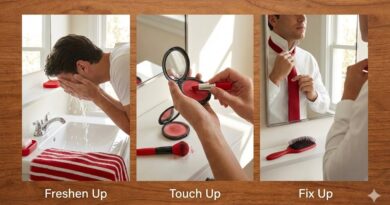
Freshen Up
Meaning: Clean yourself slightly; make yourself look/feel cleaner or more refreshed.
Usage: “I’m going to freshen up before the meeting—wash my face and fix my hair.”
Example: “After my morning run, I freshen up before starting work from home.”
Warm Up
Meaning: Prepare your body with light exercise; increase body temperature.
Usage: “I warm up with 10 minutes of stretching before my morning workout.”
Example: “Before jogging, I always warm up by walking for five minutes.”
Eat Up / Finish Up
Meaning:
- Eat up: Finish eating completely
- Finish up: Complete a task
Usage: “Eat up your breakfast—we need to leave soon!” “I’m finishing up my emails before heading out.”
Turn On / Turn Off
Meaning:
- Turn on: Activate; start (lights, appliances, devices)
- Turn off: Deactivate; stop
Usage: “I turn on the coffee maker as soon as I get up.” “Remember to turn off the lights before leaving.”
Examples: “I turn on the news while I eat breakfast.” “Don’t forget to turn off the stove!”
Set Off / Set Out
Meaning: Begin a journey; start traveling.
Usage: “We set off for the airport at 5 AM.” “I set out on my morning walk at 6:30.”
Common Patterns Across Morning Phrasal Verbs
Understanding patterns helps master new phrasal verbs.
Pattern #1: “UP” for Completion or Beginning
- Wake up (complete action of waking)
- Get up (complete action of rising)
- Dress up (complete dressing, formal clothes)
- Hurry up (intensified hurrying)
- Eat up (finish eating completely)
Insight: “Up” often signals completion, intensification, or upward movement.
Pattern #2: “OUT/OFF” for Departure
- Head out (leave)
- Head off (leave)
- Set off (depart on journey)
- Set out (begin journey)
- Take off (leave quickly)
Insight: “Out” and “off” frequently signal departure or leaving.
Pattern #3: “ON/OFF” for Activation
- Turn on (activate)
- Turn off (deactivate)
- Switch on (activate)
- Switch off (deactivate)
Insight: “On” = activate; “Off” = deactivate for devices and systems.
Creating Natural Morning Routine Descriptions
Combine phrasal verbs for natural English flow.
Basic routine:
“I wake up at 6:30 when my alarm goes off. I don’t get up right away—I lie in bed for 10 minutes checking my phone. At 6:40, I finally get up and head to the bathroom. I wash up, brush my teeth, and then get dressed. By 7:15, I’m ready to eat breakfast. I usually eat up quickly while watching the news. I turn off the TV, grab my bag, and head out the door by 7:45.”
Rushed routine:
“This morning was crazy! I woke up late at 7:30—my alarm didn’t go off! I jumped out of bed, threw on some clothes, and ran to the bathroom to wash my face. I didn’t even have time to eat breakfast. I just grabbed a granola bar and headed out the door. I was running so late!”
Relaxed weekend routine:
“On Saturdays, I wake up naturally around 9 AM—no alarm. I don’t get up immediately. I lie in bed reading for 30 minutes. When I finally get up, I take my time getting ready. I make a nice breakfast, sit down to eat, and just relax. Then I freshen up, get dressed in comfortable clothes, and head out for a walk around the neighborhood.”
Common Mistakes ESL Learners Make
Understanding typical errors prevents them.
Mistake #1: Confusing “Wake Up” and “Get Up”
❌ “I get up at 6 AM when my alarm rings.” ✓ “I wake up at 6 AM when my alarm rings.”
❌ “I wake up and immediately go to the kitchen.” ✓ “I wake up, get up, and immediately go to the kitchen.”
Why: Alarm wakes you (consciousness). You must get up before going anywhere.
Mistake #2: Using “Dress Up” for Regular Dressing
❌ “I dress up every morning for work.” ✓ “I get dressed every morning for work.”
Note: “Dress up” means formal/fancy clothes or costumes.
- “I get dressed” = normal clothes
- “I dress up” = fancy occasion
Mistake #3: Wrong Particle Placement with Pronouns
❌ “Turn on it.” / “Wake up them.” ✓ “Turn it on.” / “Wake them up.”
Rule: With pronoun objects, particle comes AFTER.
Mistake #4: Separating Intransitive Phrasal Verbs
❌ “I get immediately up.” ✗ “I wake at 6 AM up.” ✓ “I get up immediately.” ✓ “I wake up at 6 AM.”
Rule: Don’t insert words between verb and particle in intransitive phrasal verbs.
Mistake #5: Literal Translation from Native Language
Problem: Direct translation often doesn’t work.
Example (Spanish speaker): Spanish: “Me levanto” (I lift myself) ❌ English: “I lift up” ✓ English: “I get up”
Solution: Learn phrasal verbs as complete units, not word-by-word.
Why This Matters for English Learners
Phrasal verbs provide essential communication advantages.
Natural speech: Native speakers use phrasal verbs unconsciously. Mastering them makes English sound natural, not textbook-formal.
High frequency: These specific verbs appear in nearly every conversation about daily routines—essential vocabulary.
Cultural integration: Using phrasal verbs correctly signals linguistic competence and cultural fluency.
Pattern recognition: Morning routine verbs teach patterns applicable to hundreds of other phrasal verbs.
Practical application: Immediate daily use reinforces learning—you use these verbs every single day.
Comprehension: Understanding phrasal verbs dramatically improves listening comprehension of native speech.
The Bottom Line
Morning routine phrasal verbs form essential daily English:
Critical verbs mastered:
- Wake up – Stop sleeping; become conscious (can wake self or others)
- Get up – Rise from bed; stand after sleeping (physical action AFTER waking)
- Get dressed – Put on clothes (normal clothes; NOT “dress up”)
- Wash up – Wash face/hands (US); wash dishes (UK)
- Head out/off – Leave; depart
Additional important verbs:
- Get ready (prepare completely)
- Hurry up (move faster)
- Freshen up (clean/refresh slightly)
- Turn on/off (activate/deactivate)
- Eat up / Finish up (complete eating/tasks)
Critical distinction:
- Wake up = consciousness change (mental)
- Get up = physical movement (body)
- Sequence: Wake up → Get up → Continue routine
Particle patterns:
- UP = completion, beginning, upward
- OUT/OFF = departure, leaving
- ON/OFF = activation/deactivation
Grammar rules:
- Intransitive: Particle stays attached to verb
- Transitive with noun: Particle before or after noun
- Transitive with pronoun: Particle MUST come after pronoun
Common mistakes to avoid:
- Confusing wake up/get up
- Using “dress up” for regular dressing
- Wrong particle placement with pronouns
- Separating intransitive phrasal verbs
- Literal translation from native language
Key insight: Phrasal verbs aren’t optional vocabulary—they’re how native speakers actually talk. “Get up” sounds natural; “arise” sounds formal or archaic. Mastering morning routine phrasal verbs builds foundation for thousands of similar expressions while providing immediately useful vocabulary for daily life.
These verbs transform basic English into natural, fluent communication. ESL learners who master morning phrasal verbs gain linguistic tools for describing universal experiences naturally, comprehending native speech accurately, and communicating with authentic English patterns. Every morning provides practice opportunity—wake up, get up, get ready, and head out with confidence! ☀️