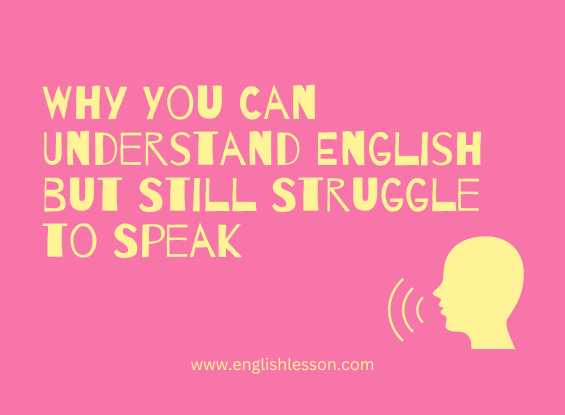
🧠 Why You Can Understand English but Still Struggle to Speak
You get what they’re saying. You nod, laugh, maybe even cry during English movies. But when it’s your turn to speak? Brain freeze. Sound familiar?
🎧 You Understand Everything… So Why Can’t You Speak?
You watch Netflix without subtitles. You understand your English-speaking boss. You know what’s going on in YouTube tutorials and podcasts. But when you try to speak? Words vanish. Sentences crumble. And your confidence? Poof.
This frustrating gap between understanding and speaking is extremely common—and it’s not because you’re bad at English. In fact, it means your brain is already halfway fluent. Let’s break down why this happens—and what to do about it.
🧩 The Science Behind the Listening–Speaking Gap
1. Passive vs. Active Skills
-
Listening = Passive Skill. You absorb and process language.
-
Speaking = Active Skill. You must create, structure, and produce language in real time.
🧠 Your brain can recognize thousands of words passively but struggle to recall even 10 in a stressful conversation.
2. Fear and Performance Pressure
Even if you know the words, your brain freezes under pressure.
Why? Because speaking often triggers fear:
-
Fear of sounding silly
-
Fear of making mistakes
-
Fear of judgment
🎤 Speaking activates not just language centers, but emotional ones too. It’s not just grammar—it’s guts.
3. Lack of Speaking Practice
Many learners spend years reading and listening, but almost no time actually speaking.
-
In school, most classes focus on writing and memorizing—not conversation.
-
Watching videos is great, but it doesn’t train your speaking muscles.
💪 Imagine trying to learn to swim by only watching videos. You’ll understand the technique—but still drown in the pool.
🛠️ How to Turn Understanding into Speaking
✅ 1. Shadowing Technique
Repeat what native speakers say—in real time.
-
Mimic their tone, pace, and pronunciation.
-
Start with 5–10 minutes daily using YouTube or podcasts.
🎧 Pro tip: Try shadowing your favorite movie scenes or TikToks. It’s fun AND powerful.
✅ 2. Practice Thinking in English
Stop translating in your head. Train your brain to think in English directly:
-
Narrate your day to yourself in English.
-
Practice inner conversations or decision-making in English.
💬 Example: “Okay, I’ll cook eggs. Then I’ll clean. Oh! I need to reply to that email.”
✅ 3. Speak Out Loud—Even Alone
Yes, it feels weird. Do it anyway.
-
Talk to yourself in front of a mirror.
-
Describe things around you: “This is a red cup. I bought it last week.”
-
Record yourself and listen back.
📱 You are your first conversation partner.
✅ 4. Join Speaking Communities
You don’t need a native speaker—you need a safe space.
-
Join online language exchange groups (e.g., Tandem, HelloTalk)
-
Practice in forums or speaking clubs
-
Create a “no-pressure” speaking challenge with friends
✅ 5. Use the 80/20 Speaking Rule
Focus on the 20% of vocabulary and sentence structures you use 80% of the time.
-
Learn useful chunks:
-
“Can I ask you something?”
-
“Let me think for a second.”
-
“What do you mean by that?”
-
📦 Fluency isn’t fancy—it’s functional.
✨ Real Talk: Mistakes Are the Path to Fluency
You won’t speak perfectly at first. You’ll fumble, pause, mispronounce. But that’s how fluency is built. Native speakers mess up too. (Yes, even them!)
💡 Each mistake is proof you’re practicing.
Silence teaches nothing. Speaking—even clumsily—teaches everything.
🚀 Final Thoughts
If you understand English but struggle to speak, you’re not broken—you’re just unfinished. You’ve already done the hard part. Now it’s time to activate your English.
And guess what? You don’t need more grammar books. You need more courage, repetition, and real conversation.
🗣️ Ready to speak confidently—even if your voice shakes?
Join our growing community of learners who are making English part of their everyday conversations at www.englishlesson.com.
Fluency isn’t a gift—it’s a habit. Start building it today.