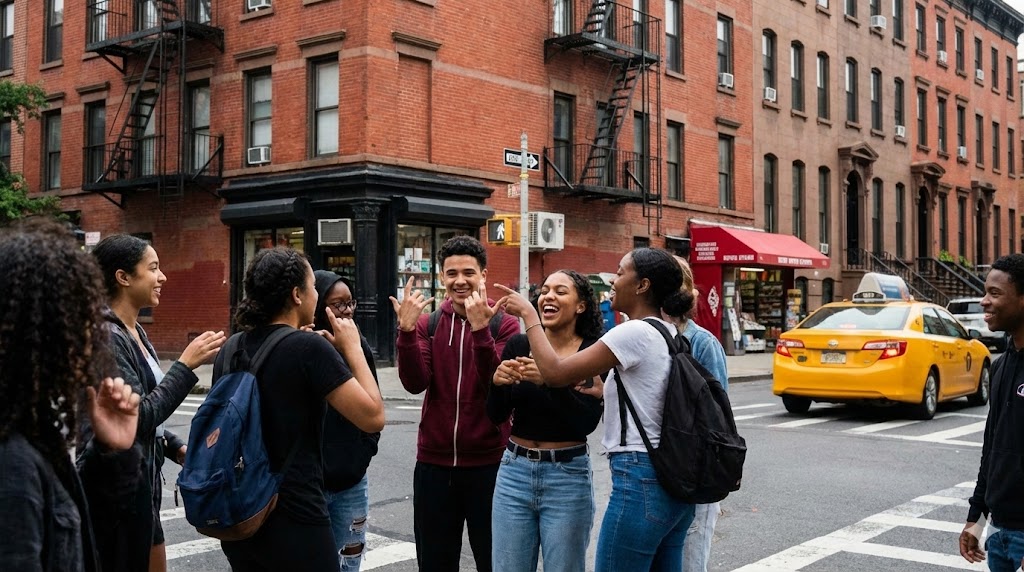
NYC Slang: How New Yorkers Really Talk 🗽
New York City—cultural melting pot and linguistic innovation hub—has generated distinctive slang that native New Yorkers use constantly to express authenticity, emphasis, location, and attitude. When New Yorkers talk about getting a “baconeggandcheese” from the “bodega,” meeting “mad” people, or insisting something is “deadass” true, they’re speaking a dialect that transforms standard English into uniquely NYC communication. Understanding expressions like “deadass,” “facts,” “brick,” “the city,” and “bodega” reveals not just vocabulary but New York culture, values, and identity. These aren’t casual regionalisms—they’re essential markers of New York linguistic identity.
Mastering NYC slang provides ESL learners and non-New Yorkers with cultural understanding, authentic communication tools, and insight into America’s most influential urban dialect. New York slang dominates American pop culture through hip-hop, television, film, and social media, making it recognizable globally. Whether visiting New York, consuming NYC media, understanding American urban culture, or simply appreciating linguistic diversity, these expressions form the foundation of how eight million New Yorkers communicate daily. New York doesn’t just have slang—it exports linguistic innovation that shapes American English nationwide.
Why NYC Slang Matters
New York slang carries significance beyond regional vocabulary.
Cultural influence: NYC slang spreads through hip-hop, comedy, film, and social media—understanding it means understanding American urban culture.
Population density: Eight million people in five boroughs create intense linguistic innovation and rapid slang evolution.
Diversity: Over 200 languages spoken in NYC contribute to unique multicultural slang mixing English, Spanish, Yiddish, Italian, and more.
Authenticity marker: Using NYC slang correctly signals cultural knowledge and insider status—misusing it reveals outsider position.
Media prevalence: New York dominates American media—TV shows, movies, music constantly feature NYC speech patterns.
Linguistic laboratory: NYC creates slang that eventually spreads nationally—today’s NYC slang becomes tomorrow’s mainstream American English.
Essential NYC Slang #1: Deadass
Meaning: Seriously; genuinely; truly; I’m being completely honest; no joke.
Usage: Emphasizing sincerity and truthfulness; indicating you’re not exaggerating or joking.
Origin: African American Vernacular English (AAVE) popularized through NYC hip-hop culture.
Pronunciation: “DEAD-ass” (two syllables, emphasis on first)
How to use it:
“I’m deadass tired—didn’t sleep all night.” “Deadass, I saw a rat carrying a full slice of pizza.” “You deadass right about that.”
Grammar variations:
Adverb (most common): “I deadass forgot” (= I seriously forgot) Adjective: “That’s deadass” (= That’s for real) Standalone response: “Deadass?” (= Really? Seriously?)
Real-life examples:
Emphasizing truth: “Deadass, the subway was so packed this morning I couldn’t breathe. Not exaggerating—literally sardine can conditions. When I say deadass, I mean it’s absolutely true.”
Responding to skepticism: Friend: “You walked from Brooklyn to Manhattan?” You: “Deadass. Took three hours but I did it.” (Emphasizing you’re not lying despite incredulous claim)
Confirming agreement: “You think rent in this city is insane?” “Deadass. I pay $2,000 for a shoebox.”
Expressing disbelief: “She said she’s never tried pizza.” “Deadass?! In New York?!” (Using as question to express shock)
Common contexts:
- Emphasizing honesty (“Deadass, I’m telling the truth”)
- Confirming wild stories (“Deadass saw a celebrity on the L train”)
- Agreeing strongly (“Deadass, that’s facts”)
- Questioning believability (“Deadass?”)
Tone and connotation: Informal/casual—not appropriate for formal business settings Signals authenticity, honesty, street credibility Associated with younger demographics and urban culture
Related NYC expressions:
“Facts” (alternative agreement/truth confirmation) “The subway is always late.” “Facts.”
“No cap” (similar to deadass—no lie) “This pizza is the best, no cap.”
“Word” (agreement/confirmation) “That’s crazy.” “Word.”
Common mistakes:
❌ Using in formal contexts (job interviews, business meetings) ✓ Reserve for casual social situations
❌ Overusing it (sounds forced/inauthentic) ✓ Use strategically for emphasis
Essential NYC Slang #2: Bodega
Meaning: Small corner convenience store, typically family-owned, selling groceries, sandwiches, drinks, household items; NYC cultural institution.
Pronunciation: “bo-DAY-guh” (three syllables, emphasis on middle)
Origin: Spanish word for “warehouse” or “grocery store,” brought by Puerto Rican and Dominican immigrants.
Cultural significance: Bodegas are NYC institutions—more than stores, they’re community centers, cultural landmarks, essential urban infrastructure.
How to use it:
“I’m running to the bodega for a sandwich.” “There’s a bodega on every corner in my neighborhood.” “The bodega cat is legendary.”
Real-life examples:
Morning routine: “Every morning I stop at my bodega for a baconeggandcheese [bacon, egg, and cheese sandwich—said as one word]. The guy knows my order—’usual?’ and I nod. That’s the bodega relationship—they know you, you know them.”
Late-night necessity: “Forgot milk for cereal. Luckily bodega is open 24/7. That’s the beauty of bodegas—always there when you need something, even 3 AM.”
Bodega cat culture: “Every proper bodega has a cat keeping the place rodent-free. Bodega cats are NYC celebrities—people take photos, create Instagram accounts for them. Part of the culture.”
Community hub: “My bodega is more than a store—I get neighborhood news there, cash checks, chat with neighbors. The owner has been there thirty years, knows everyone on the block.”
Authentic NYC marker: “Tourists call them ‘delis’ or ‘convenience stores.’ New Yorkers say bodega. It’s cultural identity—bodega means something specific, not just any store.”
What makes a bodega:
- Usually small, family-owned
- Open very long hours (often 24/7)
- Sells everything: groceries, sandwiches, drinks, household items, lottery tickets
- Often has a cat
- Personal relationship with neighborhood
- Makes custom sandwiches/breakfast items
- Typically run by immigrant families (Hispanic, Yemeni, Korean communities)
Common bodega offerings:
“Baconeggandcheese” (bacon, egg, cheese sandwich—NYC staple) “Can I get a baconeggandcheese on a roll, SPK [salt, pepper, ketchup]?”
“Chopped cheese” (ground beef, melted cheese, lettuce, tomato on hero—Harlem creation) “Chopped cheese with everything.”
Related terms:
“Bodega cat” (cat living in bodega) “The bodega cat is the real owner.”
“Deli” (sometimes used interchangeably, though bodega is more specific) Some New Yorkers use “deli,” but bodega has specific cultural connotation.
Cultural note: Calling a bodega “just a convenience store” misses the cultural significance—bodegas represent immigrant entrepreneurship, community connection, NYC neighborhood character.
Essential NYC Slang #3: Mad
Meaning: Very; a lot; extremely; many.
Usage: Intensifier emphasizing quantity or degree.
How to use it:
“It’s mad cold outside.” “There were mad people at the concert.” “That’s mad expensive.” “I’ve been waiting mad long.”
Grammar note: “Mad” functions as an intensifying adverb, similar to “very” or “really” but more casual/emphatic.
Real-life examples:
Quantity: “Mad people showed up to the protest—thousands, maybe tens of thousands. When I say mad people, I mean an overwhelming number.”
Intensity: “It’s mad hot today—like 95 degrees with humidity. Not just hot, mad hot.”
Duration: “I’ve been waiting for the Q train mad long—thirty minutes minimum. Mad long means unreasonably, frustratingly long.”
Degree: “This apartment is mad expensive—$3,500 for a one-bedroom. Mad expensive means absurdly, prohibitively expensive.”
Frequency: “I see mad rats on the subway tracks. Not occasionally—mad rats means constantly, everywhere.”
Multiple uses in one sentence: “There’s mad traffic today, it’s mad annoying, and I’m mad late for work.”
Common contexts:
- Weather: “mad hot,” “mad cold,” “mad humid”
- Time: “mad long,” “mad late,” “mad early”
- Quantity: “mad people,” “mad money,” “mad options”
- Quality: “mad good,” “mad funny,” “mad crazy”
Regional note: While “mad” as intensifier exists elsewhere, it’s particularly associated with NYC/Northeast corridor. Other regions might say “hella” (California) or “wicked” (Boston).
Formality: Informal/casual—not appropriate for formal writing or professional contexts.
Related expressions:
“Brick” (extremely, especially for cold weather) “It’s brick outside” = It’s extremely cold
“Tight” (similar emphasis) “That’s tight” = That’s cool/impressive
Essential NYC Slang #4: The City
Meaning: Manhattan (specifically); used by residents of other boroughs to refer to Manhattan.
Important distinction: To New Yorkers, “the city” means Manhattan, NOT New York City as a whole.
Usage: “I’m going into the city this weekend.” (Brooklyn/Queens/Bronx/Staten Island resident going to Manhattan) “You work in the city?” (Do you work in Manhattan?) “City kids are different from Brooklyn kids.” (Manhattan vs. other boroughs)
Real-life examples:
Brooklyn resident: “I live in Brooklyn but work in the city. Every morning I take the train from Brooklyn to Manhattan—that’s ‘going into the city’ even though technically I never leave NYC.”
Queens perspective: “Going to the city for dinner tonight—some restaurant in the East Village. When Queens residents say ‘the city,’ they specifically mean Manhattan.”
Bronx usage: “My cousin lives in the city—upper Manhattan, Washington Heights. Bronx people also call Manhattan ‘the city’ despite being part of New York City.”
Manhattan resident response: “People who live in Manhattan rarely say ‘the city’ to describe where they live—they say ‘I live in Manhattan’ or specify neighborhood. Only people from other boroughs call it ‘the city.'”
Tourist confusion: Tourist: “We’re visiting the city next week!” New Yorker: “Which part? Manhattan, Brooklyn, Queens?” Tourist: “Wait, isn’t it all ‘the city’?” New Yorker: “Technically yes, but ‘the city’ means Manhattan specifically.”
Why this matters:
Understanding this distinction signals cultural knowledge:
- “I’m going to New York” (Outsider language)
- “I’m going to the city” (Insider language from non-Manhattan borough)
- “I’m going to Manhattan” (Explicit, clear to everyone)
Related geographic slang:
“BK” (Brooklyn) “I’m from BK.”
“Queens” (always just “Queens,” no nickname) “Queens has the best food diversity.”
“The Bronx” (always includes “the”) “I’m from the Bronx.” (Not “I’m from Bronx”)
“Staten Island” (often jokingly called “forgotten borough”) “Staten Island is technically NYC but feels separate.”
“Upstate” (anywhere north of NYC, even if not actually upstate geographically) New Yorkers call everything north of the city “upstate,” even places that are technically not upstate New York.
Essential NYC Slang #5: On the Reg
Meaning: Regularly; frequently; on a regular basis.
Full phrase: “On the regular” (shortened to “on the reg”)
Usage: “I eat pizza on the reg.” “We see each other on the reg.” “That happens on the reg around here.”
How to use it:
Frequency: “I take the L train on the reg—five days a week for work. On the reg means consistently, habitually.”
Routine: “We get bagels on the reg every Sunday morning. It’s our routine—on the reg indicates regular repetition.”
Common occurrence: “Subway delays happen on the reg. Not occasionally—on the reg means this is normal, expected, frequent.”
Real-life examples:
Dining habits: “I order from the same Thai place on the reg—like three times a week. They know my voice on the phone now.”
Social patterns: “My friends and I meet for drinks on the reg. Every Thursday after work without fail.”
NYC experiences: “I see celebrities on the reg living in Manhattan. Not starstruck anymore because it happens so regularly.”
Work routine: “I work from coffee shops on the reg. Twice a week minimum, sometimes more.”
Common contexts:
- Habits: “eat out on the reg,” “exercise on the reg”
- Occurrences: “happens on the reg,” “see that on the reg”
- Social: “hang out on the reg,” “talk on the reg”
Tone: Casual, conversational—emphasizes something is routine/normal rather than exceptional.
Related expressions:
“All the time” (similar meaning, less NYC-specific) “I see him all the time.”
“24/7” (constantly) “Bodegas are open 24/7.”
Additional Essential NYC Slang
“Facts” / “That’s Facts”
Meaning: That’s true; I agree completely; statement of absolute truth.
Usage: “The subway is always delayed.” “Facts.” “New York pizza is the best.” “That’s facts.” “Rent is too high.” “Facts, no printer.” (Facts, no printer = undeniable truth)
Example: “You can’t survive in NYC without learning to walk fast.” “Facts. Slow walkers get left behind.”
“Brick”
Meaning: Extremely cold (weather); can also mean “very” in other contexts.
Usage: “It’s brick outside—bring a coat.” “The AC is brick in here.”
Origin: Possibly from feeling like you’ve been hit by a brick (due to extreme cold).
Example: “Winter in New York is brick—wind chill makes it feel 20 degrees colder.”
“Schmear”
Meaning: Spread of cream cheese on a bagel.
Origin: Yiddish influence in NYC.
Usage: “Can I get a bagel with a schmear?” “Lox and schmear on an everything bagel.”
Example: “Every Sunday I get a plain bagel with schmear from my local bagel shop. ‘Schmear’ is the New York way to say cream cheese spread.”
“Fuggedaboutit” / “Forget About It”
Meaning: Multiple meanings depending on context:
- Don’t worry about it
- It’s incredible/amazing
- No way/impossible
- You’re welcome
Origin: Italian-American NYC influence, popularized in mafia movies.
Usage depends on tone and context:
Dismissal: “You owe me $5.” “Fuggedaboutit.” (Don’t worry about it)
Amazement: “How was that pizza?” “Fuggedaboutit!” (It was amazing!)
Impossibility: “Can we walk to JFK?” “Fuggedaboutit.” (No way, too far)
“Stoop”
Meaning: Front steps of brownstone buildings where people sit and socialize.
Origin: Dutch “stoep”
Usage: “Let’s sit on the stoop.” “Stoop culture is quintessential Brooklyn.”
Example: “Summer evenings, neighbors gather on stoops—talking, drinking, watching street life. Stoop sitting is NYC social tradition.”
“Waiting on Line” vs. “Waiting in Line”
NYC-specific grammar: New Yorkers say “on line” instead of “in line.”
NYC: “I’m waiting on line for coffee.” Rest of US: “I’m waiting in line for coffee.”
Example: “The brunch spot had people waiting on line for an hour. Only in NYC do we say ‘on line’ instead of ‘in line.'”
“Hero” / “Sub” / “Grinder”
NYC term: “Hero” (large sandwich on long roll) Other regions: “Sub,” “hoagie,” “grinder”
Usage: “Can I get a chicken parm hero?”
“Pie”
Meaning: Whole pizza.
Usage: “Let’s order a pie.” “That pie was incredible.”
Example: “I’m getting a plain pie from Joe’s. When New Yorkers say ‘pie,’ we mean whole pizza.”
“Timbs” / “Timbos”
Meaning: Timberland boots—NYC fashion staple, especially in hip-hop culture.
Usage: “Wearing my Timbs.” “Classic NYC outfit: Timbs, jeans, hoodie.”
Cultural significance: Timberland boots became NYC cultural icon through hip-hop, associated with durability, style, authenticity.
How to Use NYC Slang Appropriately
NYC slang requires cultural awareness and contextual understanding.
Understanding Authenticity
Do:
- Learn slang through genuine exposure (media, conversations, immersion)
- Use sparingly until natural
- Respect cultural origins (especially AAVE-derived terms)
- Recognize regional and demographic variations
Don’t:
- Force slang into every sentence (sounds inauthentic)
- Use without understanding context/connotation
- Appropriate AAVE without acknowledging origins
- Assume all New Yorkers use all slang
Formal vs. Informal Contexts
Appropriate contexts:
- Casual conversations with friends
- Social media
- Informal writing
- Creative expression
Inappropriate contexts:
- Job interviews
- Business meetings
- Academic writing
- Formal presentations
- Professional emails
Cultural Sensitivity
Many NYC slang terms originate from:
- AAVE (African American Vernacular English): deadass, facts, no cap
- Spanish: bodega, dimelo
- Yiddish: schmear, schlep, schmuck
- Italian: fuggedaboutit, gabagool
Respect origins: Understanding and acknowledging cultural sources shows respect. Using terms without awareness can be appropriative.
Geographic Variations
Manhattan vs. Brooklyn vs. Queens vs. Bronx: Different neighborhoods and boroughs have distinct slang variations. What’s common in Harlem might differ from Park Slope Brooklyn.
Generational differences: Younger New Yorkers use different slang than older generations. “Deadass” is younger; “fuggedaboutit” is older.
Why NYC Slang Spreads Nationally
New York’s linguistic influence extends far beyond city limits.
Hip-hop culture: NYC is hip-hop’s birthplace—rap music spreads NYC slang globally through lyrics, interviews, culture.
Media dominance: Many TV shows, films, comedy specials set in NYC—characters speak NYC dialect, exposing audiences worldwide.
Social media: NYC influencers, content creators, viral moments spread slang instantaneously across platforms.
Cultural authority: NYC’s position as cultural capital gives its language prestige—people adopt NYC slang to seem cool, urban, authentic.
Examples of NYC slang gone national:
- “Facts”
- “Deadass”
- “No cap”
- “On fleek” (originally Bronx)
Common Mistakes Non-New Yorkers Make
Understanding errors helps avoid them.
Mistake #1: Overusing Slang
❌ “Yo, deadass, I’m mad excited to visit the city and get a baconeggandcheese from the bodega on the reg, facts.”
✓ Natural usage incorporates slang sparingly: “I’m excited to visit Manhattan and try a bacon egg and cheese.”
Problem: Forcing too much slang sounds inauthentic.
Mistake #2: Wrong Context
❌ Using “deadass” in job interview: “I’m deadass qualified for this position.”
✓ Formal language in formal contexts: “I’m highly qualified for this position.”
Problem: Context-inappropriate slang undermines credibility.
Mistake #3: Mispronunciation
❌ “BO-de-ga” (emphasis on first syllable) ✓ “bo-DAY-guh” (emphasis on middle syllable)
❌ “DEAD-ass” with long A sound ✓ “DEAD-ass” with short A
Problem: Mispronunciation reveals unfamiliarity.
Mistake #4: Misunderstanding “The City”
❌ “I’m visiting the city next week!” (meaning all of NYC) ✓ “I’m visiting New York next week!” OR “I’m visiting Manhattan!”
Problem: Using “the city” generically rather than specifically for Manhattan.
Mistake #5: Cultural Appropriation Without Awareness
❌ Using AAVE-derived slang without acknowledging origins or understanding context
✓ Learning, respecting, and crediting cultural sources
Problem: Appropriating language without cultural respect.
Why This Matters for English Learners
NYC slang provides multiple learning benefits.
Cultural literacy: Understanding American urban culture, hip-hop, media requires NYC slang knowledge.
Media comprehension: TV shows, movies, music frequently feature NYC speech—comprehension requires slang familiarity.
Social connection: Connecting with New Yorkers or NYC culture enthusiasts requires appropriate slang usage.
Linguistic diversity: NYC slang demonstrates how English adapts, evolves, and incorporates multicultural influences.
American English variation: NYC represents one distinctive American dialect—understanding it reveals broader American linguistic diversity.
Pop culture access: Much American pop culture originates in NYC—slang knowledge unlocks deeper cultural understanding.
The Bottom Line
NYC slang transforms standard English into distinctively New York communication:
Essential NYC slang mastered:
- Deadass – Seriously; genuinely; emphasizing truth/sincerity (AAVE origin)
- Bodega – Small corner convenience store; NYC cultural institution (Spanish origin)
- Mad – Very; a lot; extremely; intensifier emphasizing quantity/degree
- The city – Manhattan (specifically, not all of NYC)
- On the reg – Regularly; frequently; on a regular basis
Additional important terms:
- Facts / That’s facts (true; absolute agreement)
- Brick (extremely cold; very)
- Schmear (cream cheese spread—Yiddish origin)
- Fuggedaboutit (multiple meanings: don’t worry/amazing/impossible—Italian-American origin)
- Stoop (front steps where people socialize—Dutch origin)
- Waiting on line (NYC-specific: “on” not “in”)
- Hero (large sandwich—NYC term vs. “sub”)
- Pie (whole pizza)
- Timbs (Timberland boots—fashion staple)
Cultural origins:
- AAVE: Deadass, facts, no cap
- Spanish: Bodega
- Yiddish: Schmear, schlep
- Italian-American: Fuggedaboutit
- Dutch: Stoop
- Multicultural fusion: Most NYC slang reflects city’s diversity
Usage principles:
- Context matters: Informal/casual only—not formal business
- Authenticity over quantity: Use sparingly until natural
- Cultural respect: Acknowledge origins, especially AAVE
- Geographic awareness: “The city” = Manhattan to New Yorkers
- Generational differences: Some slang is age-specific
Why NYC slang spreads: Hip-hop culture, media dominance, social media, cultural authority make NYC linguistic trendsetter for American English.
Common mistakes to avoid:
- Overusing slang (sounds forced)
- Wrong contexts (formal settings)
- Mispronunciation (reveals unfamiliarity)
- Misunderstanding “the city” (means Manhattan)
- Cultural appropriation without awareness
Key insight: NYC slang isn’t just vocabulary—it’s cultural identity, linguistic innovation, and multicultural fusion. Eight million people from 200+ language backgrounds create America’s most dynamic urban dialect. Understanding NYC slang means understanding American urban culture, hip-hop, media, and linguistic diversity. Whether visiting New York, consuming NYC media, or appreciating American English variation, these expressions reveal how language evolves through cultural contact and urban intensity.
NYC slang is deadass important for understanding American English—facts, no printer! 🗽